
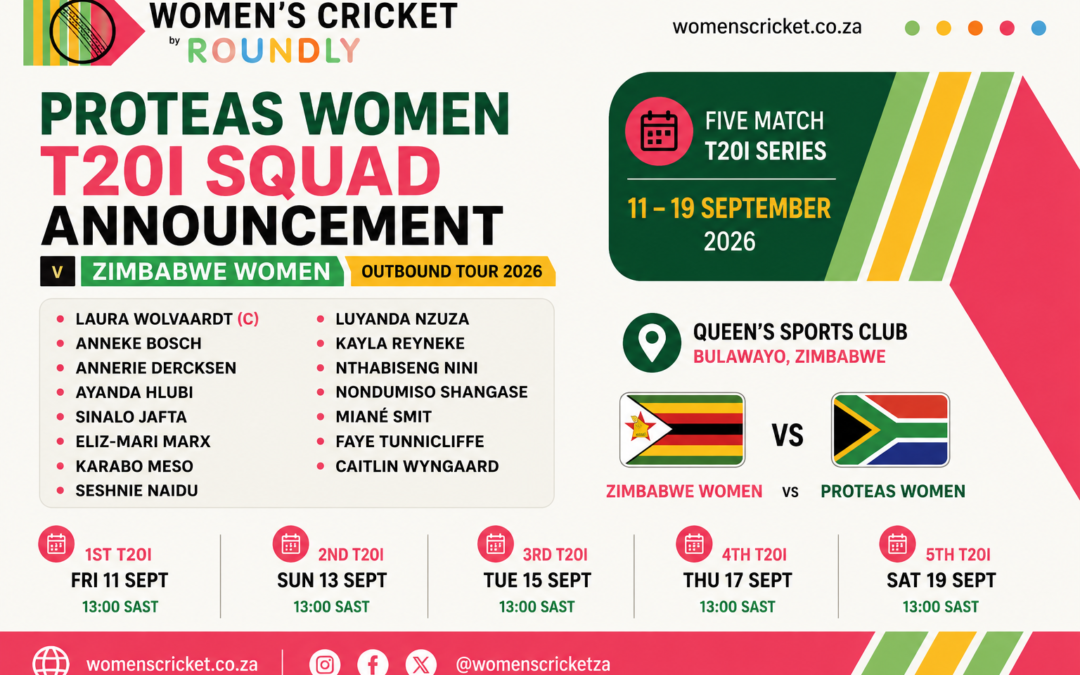
The Proteas Women have named a noticeably youthful 15-player squad for the five-match T20I series at Queen's Sports Club in Bulawayo from 11–19 September 2026.
Several established Proteas are absent, opening the door for South Africa to test its depth and, importantly, give the next generation an opportunity to show what they can do at international level.
Laura Wolvaardt remains at the helm, providing experience and stability to a group that looks very different from the side South African supporters have become accustomed to seeing.
Alongside Wolvaardt are established internationals including Anneke Bosch, Annerie Dercksen, Sinalo Jafta and Ayanda Hlubi, while younger players such as Kayla Reyneke and Karabo Meso continue their development within the senior setup.
Perhaps the most exciting selections, however, are Nthabiseng Nini, Luyanda Nzuza and Caitlin Wyngaard, who have received maiden Proteas Women call-ups after impressing at Emerging level.
A chance to look beyond the established Proteas
South Africa has spent the past few years establishing itself as a genuine contender on the world stage.
The challenge now is ensuring that success does not depend indefinitely on the same core group of players.
A number of the country's biggest names are not part of the Zimbabwe squad, creating space for players who have been waiting behind established Proteas to step forward.
Instead, players such as Eliz-Mari Marx, Nondumiso Shangase, Miané Smit and Faye Tunnicliffe return to the international conversation, alongside the three uncapped players.
That creates something South African women's cricket needs: genuine competition for places.
It is one thing to perform in domestic or Emerging cricket. It is another to put on a Proteas shirt, walk onto an international ground and be expected to deliver.
Zimbabwe gives these players that opportunity.
Zimbabwe offers the right kind of challenge
There is no point pretending Zimbabwe currently presents the same challenge as Australia, England or India.
South Africa enters the series as the considerably more established women's cricket nation.
But that doesn't make the series meaningless. Quite the opposite.
For an inexperienced player, international cricket away from home brings pressures that cannot easily be recreated in domestic competition: unfamiliar conditions, representing your country, expectations, travel and five matches in a relatively short period.
Five T20Is also provide selectors with something particularly valuable – time.
A youngster doesn't have to feel that one poor innings or an expensive bowling spell has ended her opportunity.
Give her another match. Then another. See how she responds.
The pathway is starting to matter
The selection of Nini, Nzuza and Wyngaard is particularly encouraging because it gives meaning to South Africa's Emerging programme.
Young players need to be able to see a genuine route from provincial and development cricket into the national team.
If performances at Emerging level actually lead to national opportunities, those programmes immediately become more meaningful.
The same applies to players such as Reyneke and Meso, who are already moving further along that pathway and gaining valuable experience around the senior national setup.
South Africa cannot wait until its established stars retire before discovering whether the next generation is ready.
They need to find out now.
Watch the players, not just the scoreboard
There will understandably be less attention around this tour than there was during a World Cup or a major series against Australia, India or England.
But for South African women's cricket supporters, it could be one of the more fascinating series to watch.
Not necessarily because of whether South Africa wins 5–0, 4–1 or otherwise.
Watch who takes her opportunity.
Can one of the newcomers suddenly make selectors think differently?
Can another batter force herself into the conversation?
Can Reyneke or Meso take another step towards becoming permanent Proteas?
Can someone currently considered a fringe player leave Zimbabwe looking like a future first-choice international?
Those are the questions that matter.
Proteas Women Squad – Zimbabwe Tour
Laura Wolvaardt (c), Anneke Bosch, Annerie Dercksen, Ayanda Hlubi, Sinalo Jafta, Eliz-Mari Marx, Karabo Meso, Seshnie Naidu, Nthabiseng Nini, Luyanda Nzuza, Kayla Reyneke, Nondumiso Shangase, Miané Smit, Faye Tunnicliffe and Caitlin Wyngaard.
More than five matches against Zimbabwe
South Africa has already shown that it belongs among the leading nations in women's cricket.
The next challenge is building enough depth to remain there – and ensuring that when the established generation eventually moves on, another group is ready to take over.
Zimbabwe 2026 gives that next group their chance. And for some of these players, five matches in Bulawayo could be the beginning of something much bigger.
